

ARTICLE
Fasting Siddhartha, Lahore Museum

Visual features
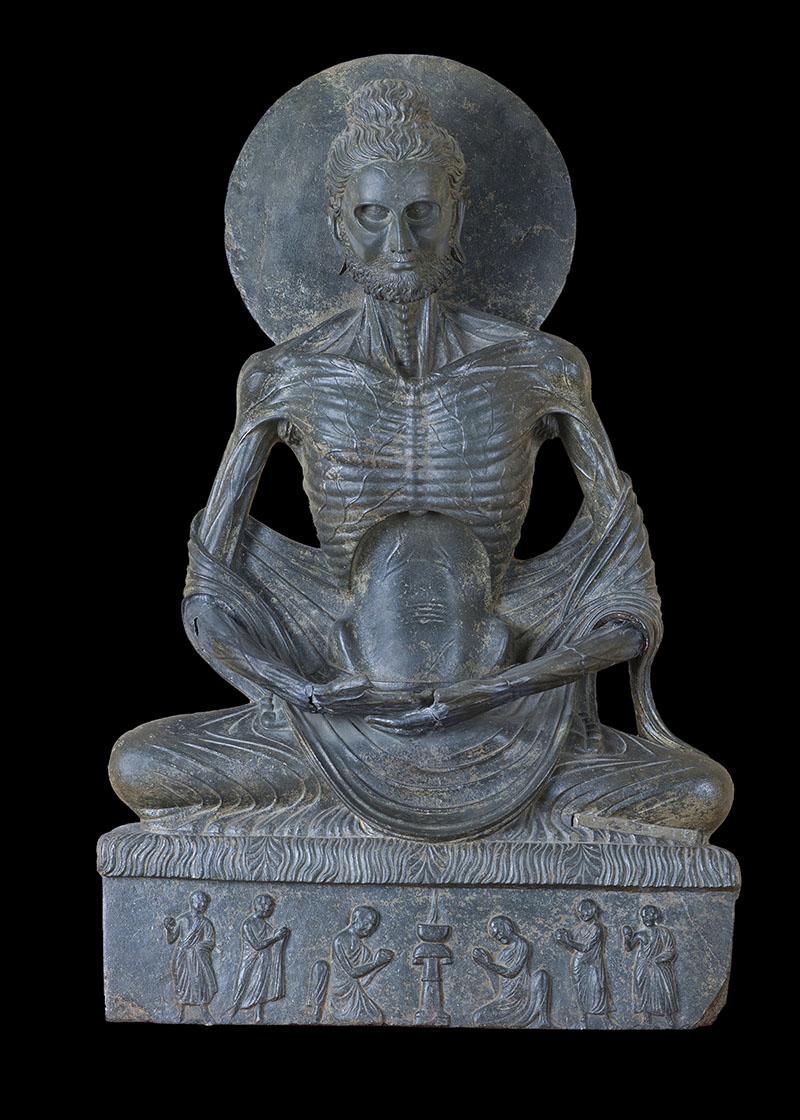
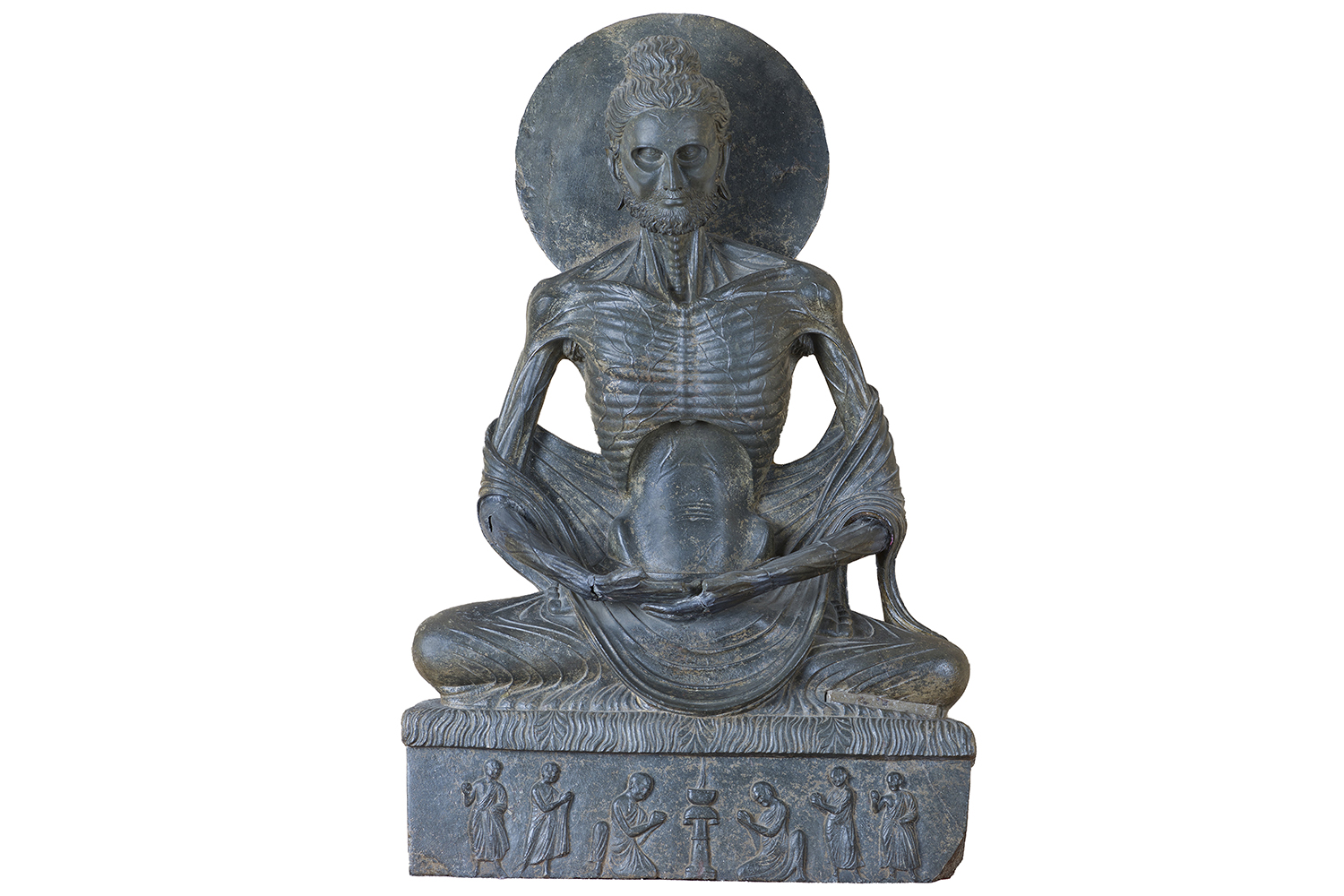
The sculpture is about 84 centimetres tall, 53 centimetres wide, and 25 centimetres in depth. It depicts the Buddha as an emaciated figure with a thick beard, seated on a plinth on which are carved six other figures. The Buddha is shown in meditation, with his legs crossed in padmasana (lotus pose), his hands placed on his lap in dhyana mudra, and eyes half closed. His hair is done in the topknot common in Gandharan Buddhist imagery; behind his head is a large circular disc generally interpreted as a halo. While his upper body is bare, he wears a thin lower garment and a length of cloth draped loosely around his arms, covering both elbows and the front of his legs; the folds of the fabric are naturalistically rendered. The protrusions and hollows of his ribs, neck, pelvic bones, stomach, armpits, and eyes sockets have been treated in high relief, creating sharp contrasts of light and shadow. Various veins, tendons and bones are emphasised, and rendered with great anatomical accuracy, reflecting the naturalism of classical Greco-Roman art that influenced Gandharan art. A few fingers are missing from breakage, and cracks are visible on both elbows, right wrist, and left hand.
The Buddha’s seat is rendered as a grass cushion. Beneath this, the front of the plinth shows six male figures carved in low relief, likely his disciples. Their posture and their draped robes are rendered as distinctly Greco-Roman. They are symmetrically arranged on either side of a ceremonial fire stand or flaming torch, two kneeling in the centre, and the four others standing. According to some scholars this is a representation of an esoteric ritual practised by Buddhist initiates in ancient Gandhara.
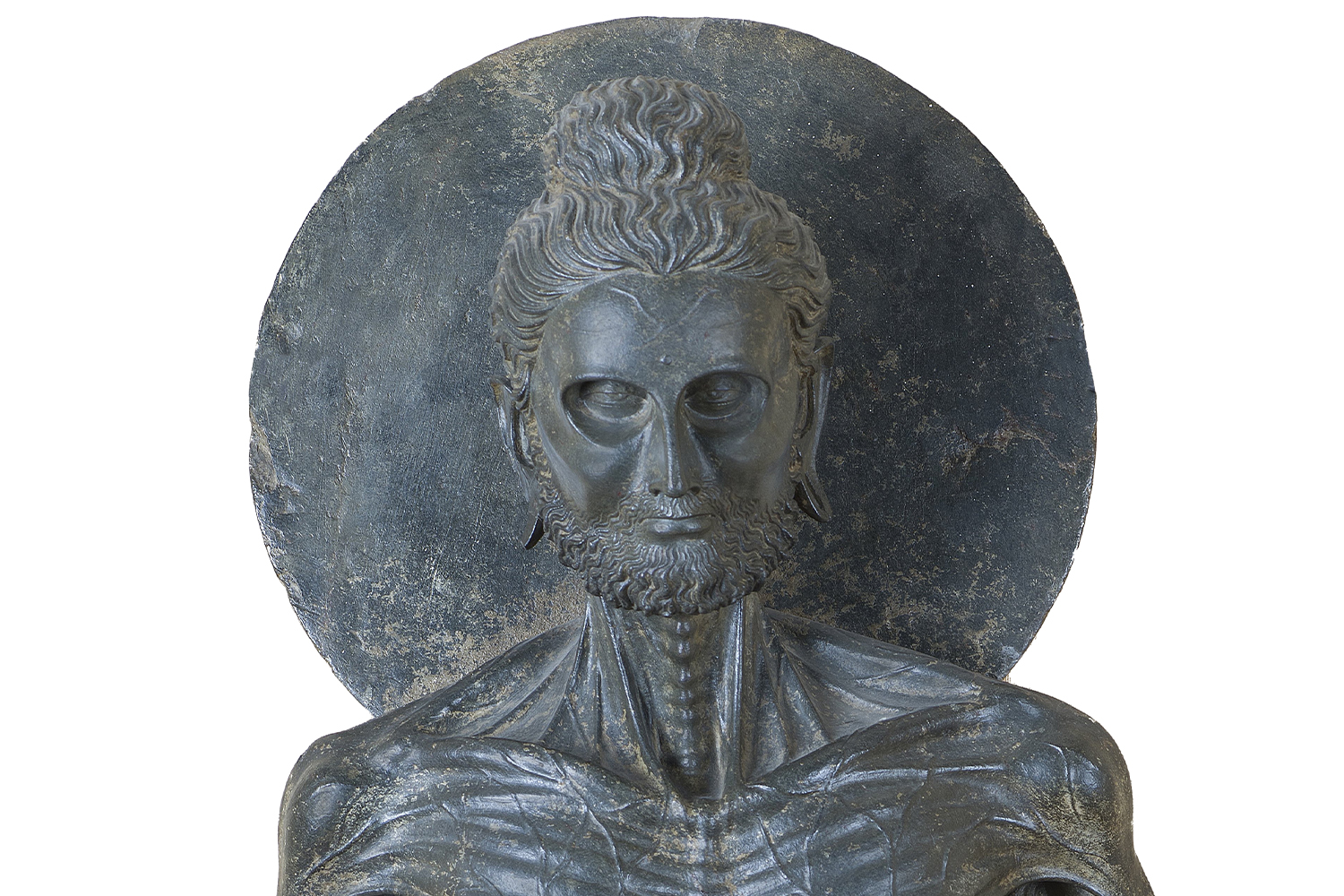
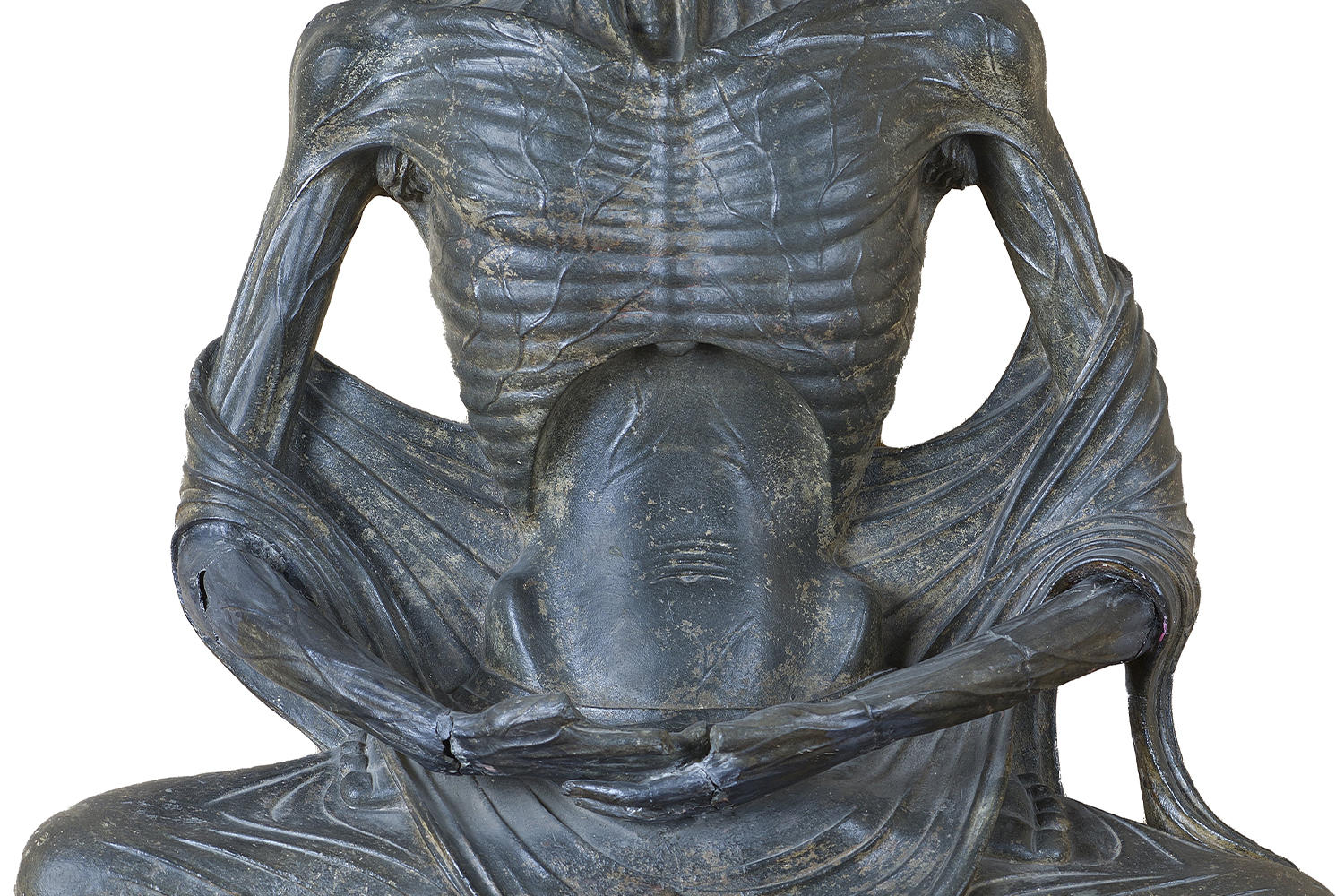
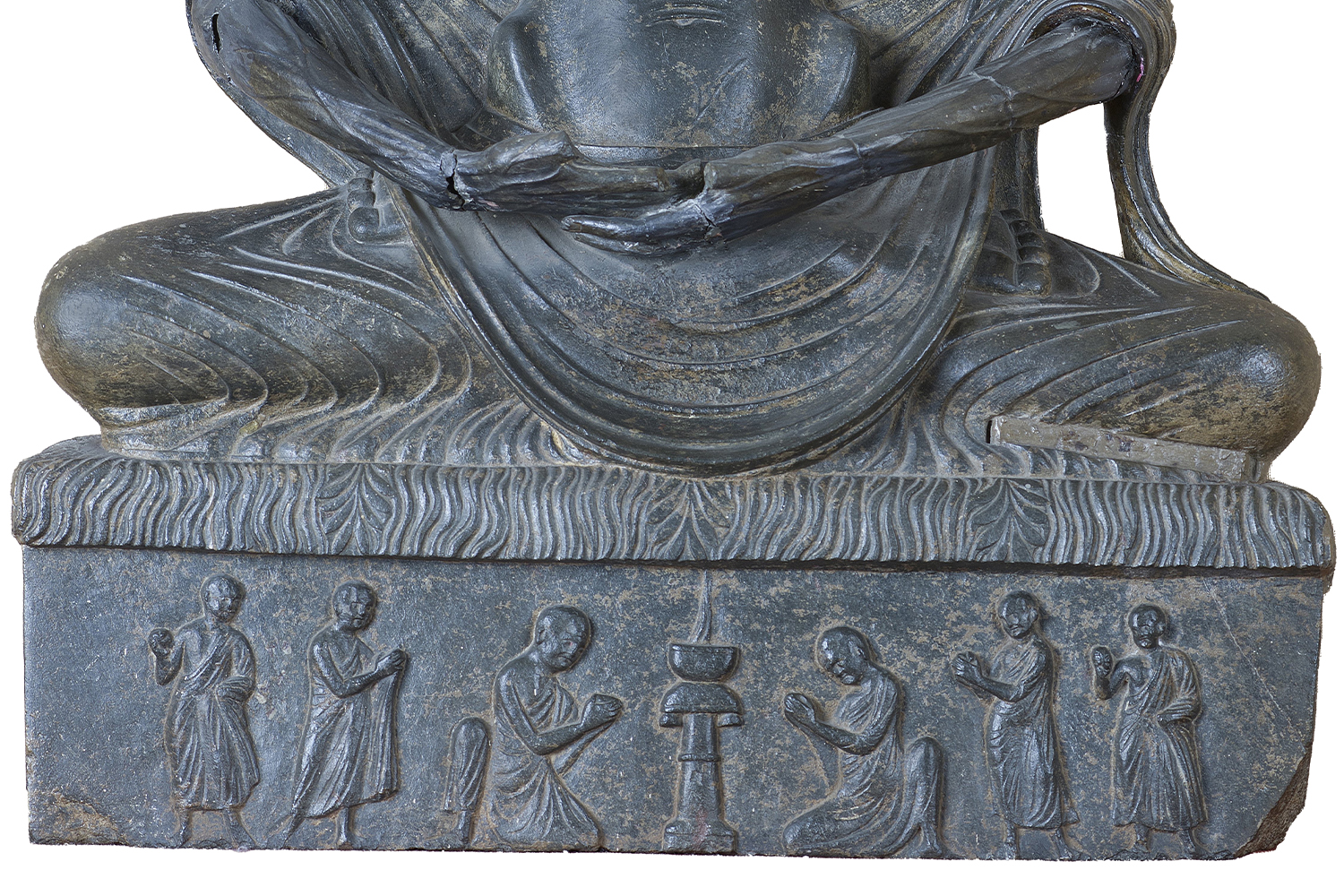
In 2012, damage during routine cleaning deepened the crack on the left arm; the subsequent decision to repair it with epoxy — which caused further damage — rather than following proper conservation procedures, has come under criticism.
Iconography and interpretation
Gandharan art commonly depicted narrative imagery from the Buddha’s life, of which the prince Siddhartha Gautama’s renunciation and austerities in pursuit of Buddhahood or enlightenment is one recurring theme. He is said to have undertaken a six-year fast, before realising that extreme austerity was not the path to spiritual liberation. After attaining enlightenment at Bodh Gaya, he undertook another, gentler forty-nine-day fast. These austerities are narrated and discussed extensively in Sanskrit sacred biographies and poetry such as the Lalitavistara, Buddhacharita, or Karunapundarika-sutra, and in the Pali Tipitaka scriptures of Theravada Buddhism. Within these texts, scholars have read varying attitudes towards the Buddha’s extreme fasting, with some emphasising his ultimate rejection of austerity as the path to enlightenment, and others extolling his heroism and resilience in states of extreme deprivation. The relationship between these textual sources and the images in Gandharan art is debated, but the texts have offered scholars clues to interpret the significance of the images in historical context.
Interpretations of the Fasting Buddha image vary; there is also debate on whether this particular sculpture refers to Siddhartha Gautama’s pre-enlightenment six-year fast, or his latter fast as the Buddha. Some scholars have pointed out the Gandharan artists’ curious choice to depict the very same extreme austerities that the Buddha ultimately decided were unnecessary, speculating that this could be the reason the image did not gain much popularity in Indic Buddhist art. The image could also be an allusion to asubha-bhavana, a form of Buddhist meditation that involves the contemplation of death and the corpse so as to remind the devotee of the perishability of their own body.
Other specimens
Other noteworthy examples of Gandharan schist sculptures of the Fasting Buddha include the Fasting Buddha at the Peshawar Museum, which is in a greater state of disrepair, and the Fasting Buddha Shakyamuni at the Metropolitan Museum of Art, New York, in which the head is missing. The seventh-century travelogue of Xuanzang describes a sculpture of the emaciated Buddha being worshipped at Bodh Gaya for curative properties believed to arise from its association with disease and health. In the early twentieth century, a Gandharan Fasting Buddha was found in Mathura, present-day northern India, and is now housed at the Mathura Museum. The Fasting Buddha also appears at Chinese cave sites from the fifth century CE on, in an eighth-century ivory carving from Kashmir, and at Buddhist sites of worship in Nepal, Burma, Thailand, and Sri Lanka.
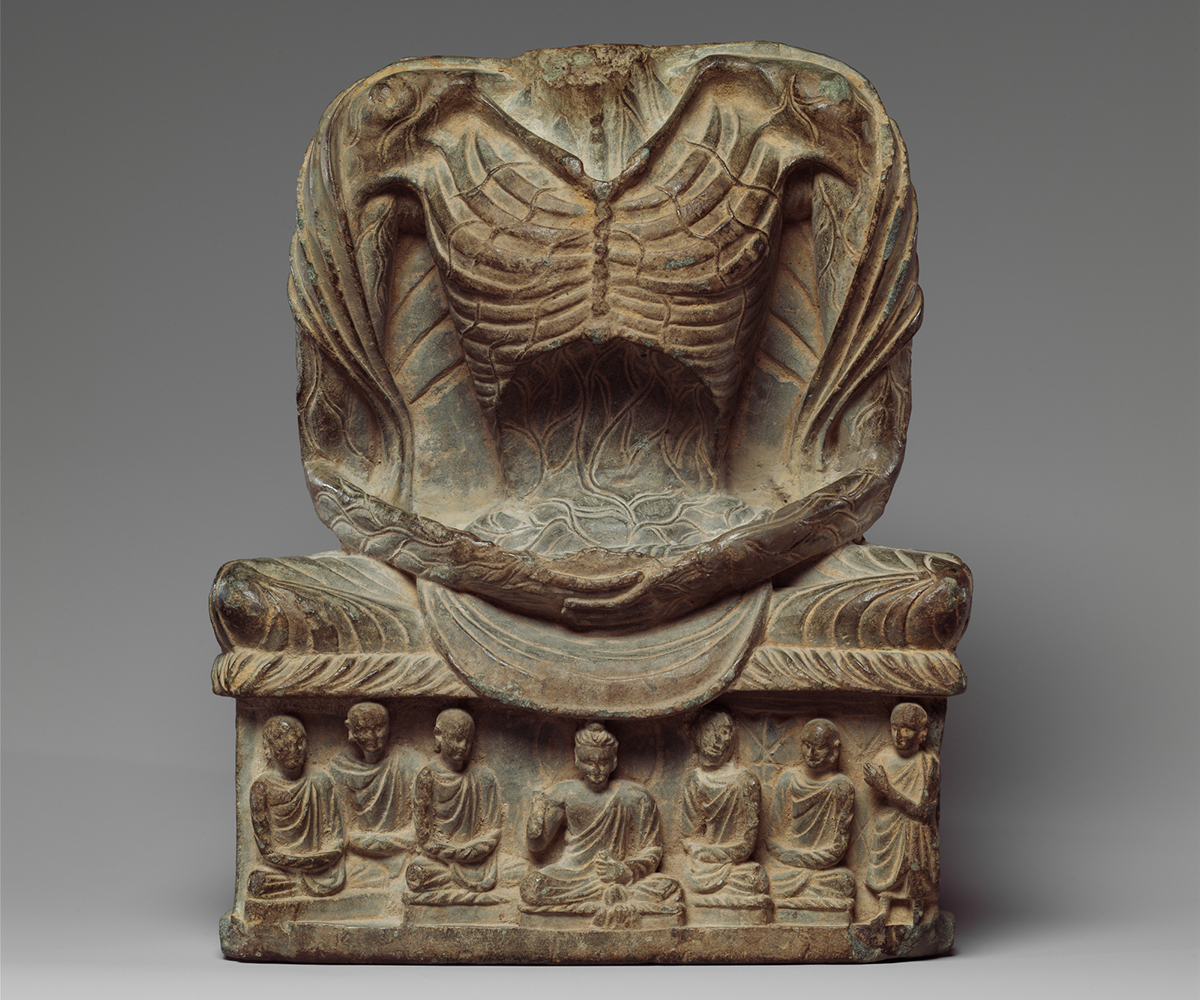
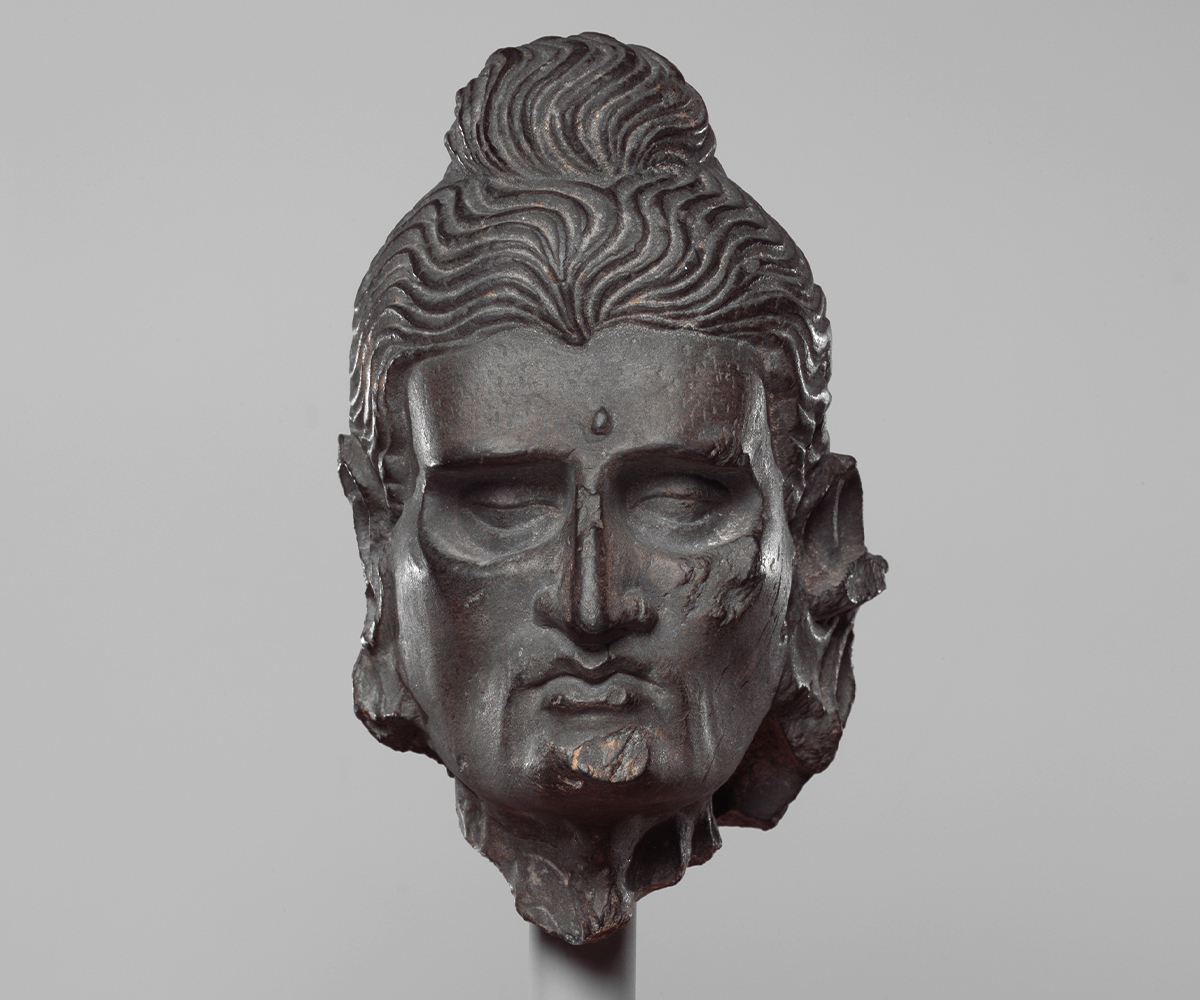
Evidence suggests that for most of premodern history, the Fasting Buddha was not a widely popular image of worship. However, it gained further popularity after widespread excavations in the Gandharan region in the nineteenth century led to a rediscovery and reinterpretation of Gandharan images among modern Buddhists, especially Theravada Buddhists in Thailand and Sri Lanka. Modern depictions of the Fasting Buddha here loosely replicate Gandharan conventions and tend to link the image with the six-year fast of Siddhartha Gautama.
Bibliography
Ahmed, Shoaib. “‘Fasting Buddha’ Damaged further during Cleaning.” Dawn, June 26, 2014. Accessed November 21, 2023. http://www.dawn.com/news/1115168.
Awan, Arshad. “The Agony before Enlightenment.” T Magazine, May 22, 2022. https://tribune.com.pk/story/2357686/the-agony-before-enlightenment.
Behrendt, Kurt A. “Gandhāran Imagery as Remembered by Buddhist Communities across Asia.” In The Rediscovery and Reception of Gandharan Art: Proceedings of the Fourth International Workshop of the Gandharan Connections Project, edited by Wannaporn Rienjang and Peter Stewart, 107–24. Oxford: Archaeopress, 2022.
Brown, Kathryn Selig. “Life of the Buddha.” In Heilbrunn Timeline of Art History. New York: The Metropolitan Museum of Art, 2000–. http://www.metmuseum.org/toah/hd/buda/hd_buda.htm (October 2003).
Brown, Robert. “The Emaciated Gandharan Buddha Images: Asceticism, Health, and the Body.” In Living a Life in Accord with Dharma: Papers in Honour of Professor Jean Boisselier on his Eightieth Birthday, edited by N. Eilenberg, M. C. Subhadradis Diskul, and R. Brown. Bangkok: Silpakorn University Press, 1997. http://subhadradis.su.ac.th/uploads/BK-04-08-001.pdf
Hamal, Koshal. “The Fasting Siddhartha Sculpture: Hellenistic Influence and Symbolic Meaning.” Lalitkala Pragya 1 (2025): 65–79. https://doi.org/10.3126/lp.v1i1.78643.
Lahore Museum. “Fasting Siddhartha.” Google Arts & Culture. Accessed November 21, 2023. https://artsandculture.google.com/asset/fasting-siddhartha/QgGcgQazjovxxg.
Mogali, Sreenivasulu Reddy, and Peter Abrahams. “Human Anatomy in Ancient Indian Sculptures of Gandhara Art Illustrating the Fasting Buddha.” European Journal of Anatomy 21, no. 4 (2017): 287–91.
Quagliotti, Anna Maria. “New Considerations on Some Gandharan Fasting Buddhas.” In Miscellanies About the Buddha Image: South Asian Archaeology 2007, Special Sessions 1, edited by Laura Toti and Fabio M. R. Rulli. Bologna: University of Bologna, 2007.
Rhi, Juhyung. “Fasting Buddhas, Lalitavistara, and Karuṇāpuṇḍarīka.” Journal of the International Association of Buddhist Studies 29, no. 1 (2006): 125–53. https://journals.ub.uni-heidelberg.de/index.php/jiabs/article/view/8975.
Victoria and Albert Museum. “Lockwood Kipling: Collecting and Curating Gandharan Buddhist Sculptures.” Accessed November 21, 2023. https://www.vam.ac.uk/articles/lockwood-kipling-collecting-curating-gandharan-buddhist-sculptures.
Voon, Claire. “The Raw Expression of a Rare, Emaciated Buddha.” Hyperallergic, December 13, 2016. Accessed September 18, 2024. https://hyperallergic.com/344879/the-raw-expression-of-a-rare-emaciated-buddha/.
Wang, Jessica. “Gandhara Art and Emaciated Buddha.” Asian Art and Architecture. May 17, 2021. Accessed September 18, 2024. https://diluo.digital.conncoll.edu/Asianart/exhibition/emaciated-buddha/.